
Temperament and Idols: Reaction and Motivation
Our Automatic Patterns
In every situation, people tend to fall into familiar patterns. These patterns are reactionary and often automatic. When we take time to reflect on them, we begin to see that they are innate—present since childhood.
What Temperament Reveals
These reactions point us to our temperaments.
We can be choleric, melancholic, sanguine, phlegmatic, or some combination of the two. Temperaments describe the speed—fast or slow—and the depth—shallow or deep—of how we respond to events. From these patterns, certain personality tendencies emerge, giving us a clearer understanding of ourselves.
I remember learning about the temperaments and feeling as though I had been given the key to a lock. I began to see the differences between my reactions and my wife’s. I learned how to more effectively teach a wide variety of students. Over time, this understanding helped me become a better leader, teacher, husband, father, and man.
The Limits of Temperament
However, I also noticed that temperaments had limits.
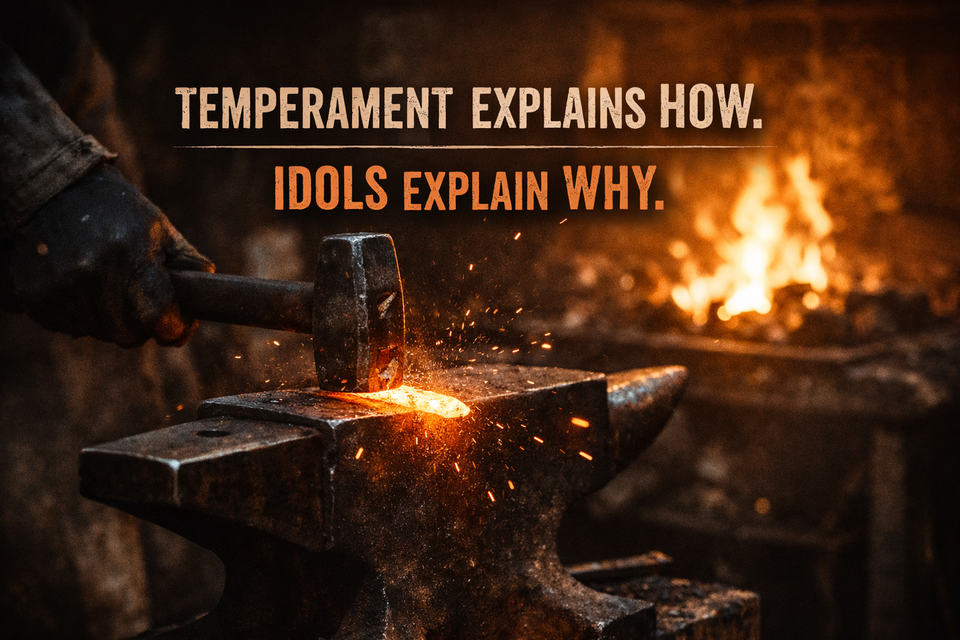
While they helped me understand how people reacted, they didn’t always help me discern why. I could predict responses, but I still struggled to understand a person’s deeper motivation. Recently, while listening to a Fr. Mike podcast, I received the other piece of the puzzle: the four idols.
The Four Idols
During the podcast, four common idols were laid out—drawn from the Christian tradition—that people tend toward: power, money, fame, and pleasure. Like temperament, these tendencies can often be observed from childhood.
- Power is the desire for control and influence over others
- Fame desires admiration, approval, and being known
- Money looks to accumulate and secure wealth
- Pleasure looks for comfort and to feel good
When Good Things Go Wrong
None of these are wrong in themselves. Problems arise when we seek them above all else.
Power, when used properly, protects others and builds. When used improperly, it corrupts the person.
Money can fund great works of art or provide charity to those in need. But when it is accumulated for its own sake, we slowly become a dragon sitting on a pile of gold.
A Personal Example
Discovering our own idol allows us to recognize and combat its effects. For me, that idol is fame. I want to be known, liked, and appreciated. I am deeply hurt when someone misrepresents me or attacks my name. This idol plays a role in why I create this newsletter, why I ran for the local city council, and why I struggle following certain leadership styles.
This idol is part of who I am, just like my temperament is. And like my temperament, it is a tool that can be used well or poorly.
My desire for fame can push me to step out of my comfort zone and be known. I can use that motivation to serve myself and do whatever it takes to grow my name. Or it can be tempered and integrated so that I step forward to lead others with a servant’s heart.
Reaction and Motivation Together
Idols reveal our motivations and, when properly integrated, allow us to better serve those around us. When they are focused solely on ourselves, they become a vice that will eventually consume us.
When temperaments—our reactions—are paired with idols—our motivations—we gain a fuller picture of who we are. We can better understand our gifts, our weaknesses, and where formation is needed. We can grow in virtue and become the men we are meant to be.
Reflection for the Week
This week, don’t just identify your idol—watch it.
Pay attention to what angers you, what you defend, and what you fear losing. Those moments reveal what you serve.
Then ask yourself:
How can this motivation be disciplined and ordered toward serving others instead of myself?
Forge Ahead
Anvil: the place of formation.
Arrow: the mission we’re sent on.
The world needs more men formed in virtue. Forward this to a brother who’s ready to grow.
Want more? Subscribe to Anvil & Arrow and join a community of men committed to forging strength, virtue, and legacy.
Member discussion