
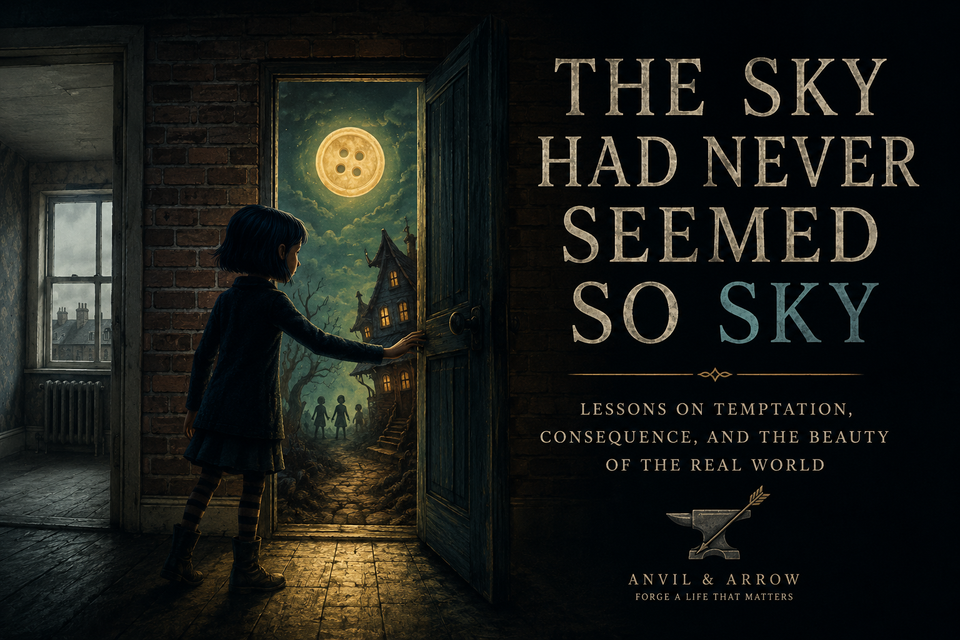
The Sky Had Never Seemed So Sky
G. K. Chesterton once wrote:
“What fairy tales give the child is his first clear idea of the possible defeat of bogey… What the fairy tale provides for him is a St. George to kill the dragon.”
I would take his quote one step further and say that it is not just for children, but also for adults. Fairy tales have an incredible ability to capture grand truths and present them with remarkable clarity. Evil exists, courage matters, and darkness can be defeated.
While today’s media often tries to complicate our lives, fairy tales provide simplicity in the best way possible.
One modern fairy tale that has captured my imagination is Coraline.
The Door
Coraline is a normal girl living in the UK. She is an explorer who is bored with the world she is exploring. Nothing catches her attention except for the door that opens to a brick wall.
It puzzles her: Why would this door exist?
She is even more intrigued when the crazy man upstairs tells her not to enter the door. Curiosity gets the best of her. She unlocks the door, opens it, and sees a tunnel.
Before entering, she has a thought:
“What I am doing is wrong.”
She has been warned, but she enters anyway.
What she finds on the other side is her own flat. Nothing seems extraordinary at first until she meets a “woman” who looks just like her mother.
This woman introduces herself as the other mother, stating that all kids have another family. The other mother is eager to dote on Coraline, giving her everything she could ever want. Coraline spends the day exploring the world created just for her.
After enjoying the best day of her life, Coraline is told she can stay forever.
She just has to do one thing:
Allow the other mother to replace her eyes with buttons.
The Cost of the Wrong Door
Coraline is rightly horrified and leaves for the real world. When she gets home, she learns a valuable lesson: our sins impact others, not just ourselves.
The other mother has captured Coraline’s parents to lure her back. Coraline knows what she must do. She must face her mistake and rescue her parents.
With courage, she enters the other world.
She confronts the other mother and is punished for bad behavior. She is placed in a closet until she learns to behave. This is when she learns a sad truth.
Coraline is not the first child to enter this other world.
The other mother, who is actually the Beldam, has claimed the souls of three children. They entered her world, fell for the wonders that the Beldam presented, let her replace their eyes with buttons, and then she took their lives.
They ask Coraline to find their souls and take them to the real world so they can finally rest.
Coraline challenges the Beldam to a game of exploring and finding. Coraline states that she will find the souls and her parents. If she can do that, she wins the game, freeing everyone and herself. If she can’t, she will allow the other mother to replace her eyes.
The Beldam accepts.
Through many trials, Coraline finds the souls, rescues her parents, and escapes to the real world.
After this adventure, Coraline has a newfound appreciation for the real world. She sees the wonder and beauty in the ordinary. She thinks:
“The sky had never seemed so sky, the world had never seemed so world.”
If you enjoy reflections like this, subscribe to Anvil & Arrow for weekly essays on virtue, leadership, sacrifice, and the stories that shape us.
Dissatisfaction and Temptation
The adventure that Coraline enters changes her and provides us with a few lessons.
The first is that temptation can arise from dissatisfaction and lack of appreciation.
Coraline is a typical child who craves novelty. She hasn’t learned to enjoy the mundane but beautiful world around her. Instead, she looks to other things, leading her to open the door and meet the other mother.
We may think she is ridiculous, but how often do we do the same?
We can live a fantastic life filled with invaluable relationships, family, wealth, and graces. Even with all that, we can still become bored and unsatisfied.
Coraline indulges in her curiosity, even when she knows she is doing the wrong thing. We can do the same by endlessly scrolling on our phones, indulging in gossip, or growing envious of others.
We aren’t immune to this temptation, and the best way to combat it is to regularly count our blessings.
Our Choices Affect Others
Another lesson is that our sins do not impact us alone.
Modern culture constantly tells us that our private choices only affect ourselves. What we watch, indulge in, fantasize about, or obsess over is supposedly “our business.” Coraline reminds us that this simply is not true.
Coraline is an example of reality. She knows what she is doing is wrong, but still enters the door. That choice leads to her parents being captured.
They didn’t enter the other world, but they still paid the price for their daughter.
God Can Bring Good From Our Mistakes
However, this story also shows the power of God to bring about good from our mistakes.
Coraline should have never entered that door; it was a huge mistake.
However, because she did, she found the souls of the children. Without her entering the other world, the children may have stayed there potentially forever.
This reminds us that even when we make mistakes, we aren’t irredeemable. God often works with our mistakes to bring about a greater good.
Challenge
This week, take inventory of the “doors” in your own life.
What habits, distractions, temptations, or comforts promise fulfillment but slowly pull you away from gratitude, reality, and responsibility?
Then do one intentional thing to reconnect with the real world:
- Put down your phone
- Spend time with your family
- Go outside
- Pray intentionally
- Read a good book
- Call a friend
Like Coraline, many of us only rediscover the beauty of reality after we nearly lose sight of it.
Next Week
Finally, I want to focus on the other world itself. However, I will do this by juxtaposing it to the land of The Lion, the Witch and the Wardrobe in the next editorial.
Two doors. Two worlds. Two very different creators.
Forge Ahead
Anvil: the place of formation.
Arrow: the mission we’re sent on.
The world needs more men formed in virtue. Forward this to a brother who’s ready to grow.
👉 Want more? Subscribe to Anvil & Arrow and join a community of men committed to forging strength, virtue, and legacy.
Member discussion