
The Talents We Bury
Anvil & Arrow – Issue 2
As a kid, two things shaped my vision of manhood: a visual and a parable.
The visual was of St. Joseph in his workshop with young Jesus—a life of quiet dignity. It revealed the beauty of ordinary days done with honor. Jesus himself lived a hidden life before his public ministry.
That peaceful rhythm—work, family, rest—still calls to many of us.
It’s an honorable life.
But then there’s the parable of the talents (Matthew 25:14–30). One servant buries his gift out of fear. The master returns—not with comfort, but with judgment.
That story shifted my view:
My talents aren’t mine to protect.
They’re given by a Master who expects growth.
Fear cannot be my excuse.
I may desire a quiet life, but obedience may demand I step into discomfort.
Both the visual and the parable reveal something deeper:
I need humility to know my true talents, and prudence to use them rightly.
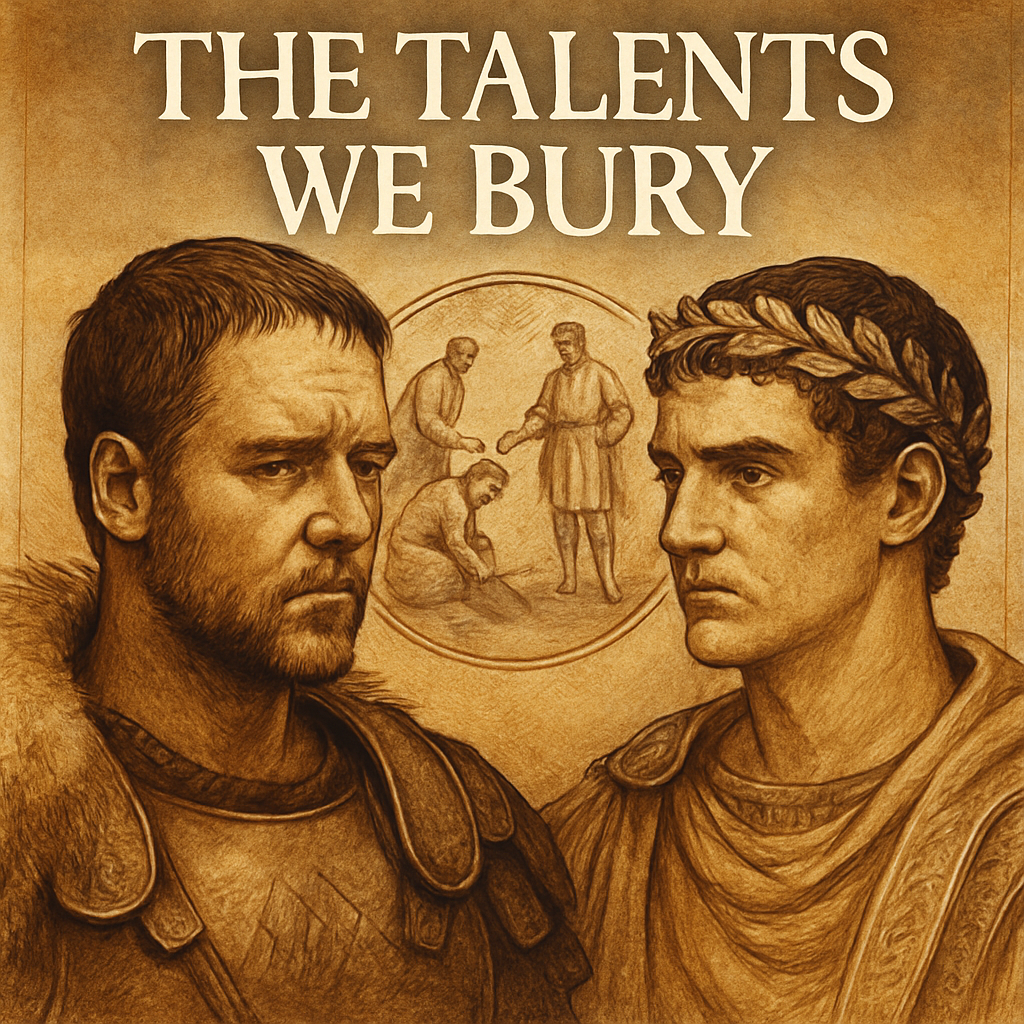
Maximus and Commodus: A Tale of Two Men
We see this tension in one of my favorite films—Gladiator.
Maximus and Commodus both have talent.
But only one chooses virtue.
Maximus: The Talented Servant
When we meet Maximus, he’s preparing for battle. Others believe the barbarians should surrender—they’re beaten.
But Maximus understands them. He sees their reasons for resisting, not just their odds of winning. He’s not fighting to dominate—he’s fighting to protect.
He doesn’t crave power.
He longs to return to his farm, his wife, and his son.
Yet when the emperor asks him to lead, Maximus obeys—not because he wants to, but because he must.
He has the humility to know who he is, and the prudence to step up when duty calls.
He is what we aspire to be: a man of blood and iron, fierce when needed, yet deeply meek.
As C.S. Lewis wrote:
“The knight is not a compromise between ferocity and meekness; he is fierce to the nth and meek to the nth.”
Commodus: The Wasted Talent
Commodus also has talent—but he is ruled by pride.
He play-fights to feel powerful but has never truly grown up. He knows what he wants—to be emperor—but has no vision beyond himself.
When his father names Maximus as successor, Commodus snaps.
He murders his own father in secret and grabs power at any cost.
He does not want to serve—he wants to be served.
What This Means for Us
Maximus is a man of virtue who answers the call, even when it costs him everything.
Commodus is a man without virtue who seeks power, even if the world burns.
We’re called to be like Maximus: men who know our gifts and are ready to use them for the good of others.
If we don’t rise to the moment, someone like Commodus will.
The stakes are high. This is a responsibility we can’t take lightly.
But we cannot do this blindly.
The first step is self-knowledge.
We must take inventory of the talents we’ve been given—not with pride, but with clarity—so we can develop them and deploy them in the right moments.
Next Step: Talent Inventory
Next week, I’ll send you a Talent Inventory Tool to help you:
- Identify your unique talents
- Get feedback from others
- Spot weak points to grow
- Start building a plan to serve with purpose
In the meantime, I challenge you to reflect and ask trusted people around you:
What strengths do you see in me?
This is the work of the anvil—shaping the raw material into something strong.
But it’s also the work of the arrow—meant not to sit idle in the quiver, but to be loosed into the world.
The world needs what you carry.
Forge it now, so you’re ready to serve when the moment comes.
Until next week—forge ahead.
Let’s Connect:
- Leave a comment or reply:
What talents do you suspect you have, and which ones do you fear you’re burying? - If someone came to mind while reading this, forward it to them.
Let’s walk this journey together.
Anvil: the place of formation.
Arrow: the mission we’re sent on.
Member discussion