
The Strength of Limits
Growing up, I remember being inundated with a common phrase: “You can be whatever you want to be.”
I heard it in sports, in school, and on television. It was meant with the best of intentions — but it was incorrect.
No matter how much I tried, there will always be certain things I cannot do. I have limitations.
Some may view this as negative. But limitations can focus our efforts and help us maximize our impact.
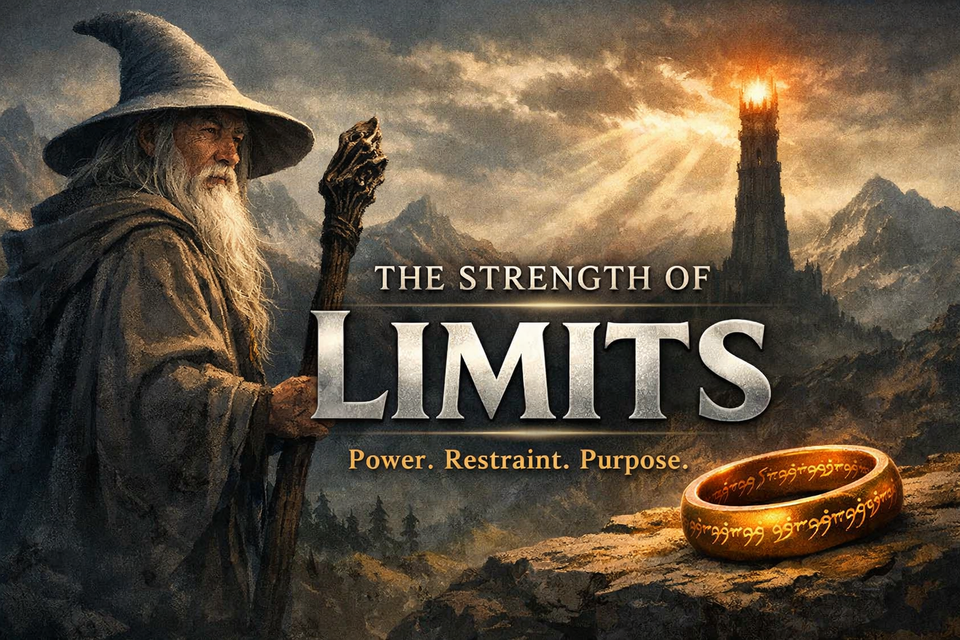
One character who illustrates this beautifully is Gandalf.
Power and Mission
You may say, “Why Gandalf? He is one of the most powerful beings in Middle-earth.”
That’s true. But we have to consider why he was sent to Middle-earth in the first place. He was sent to assist the free peoples against Sauron and help them stand on their own. His mission was not domination. It was guidance.
To accomplish his goal, he could have dominated others, forcing them into submission. We actually see this play out with Saruman. Saruman was meant to be the leader of the wizards, giving wise counsel and strengthening the free peoples. Instead, his desire for power consumed him, and he began to dominate the surrounding regions.
Gandalf is given the opportunity for immense power when Frodo offers him the Ring. Gandalf refuses. He tells Frodo not to tempt him. He knows what would become of him if he took it. He would be powerful — but he would be a tyrant and unfaithful to his mission.
Gandalf’s greatness is not that he lacked power, but that he refused power outside his mission.
Power without purpose corrupts.
Power within limits builds trust.
Even with his strength, he accepts his limitations.
The Allure of More
The allure of power — thinking it will remove our limitations — is a folly many of us fall into.
We tell ourselves that if we could just achieve a certain skill, title, level of authority, or financial success, we would finally be able to do the most good. We believe our limitations are the obstacle to impact.
I felt this as a teacher.
If I could just be a principal, I could influence more teachers and thus, more students. It sounded noble. But I lacked the virtues to lead. I was striving for more that wasn’t mine. I was becoming Saruman.
Instead of accepting where I was called to serve, I was grasping for influence.
What Limitations Really Are
Limitations are not good or bad. They are neutral. They are reality.
We all want to accomplish certain things and become certain people. But the reality of this world will challenge that. When we encounter limitations, we have two options:
We can become bitter and force the issue — ignoring the limits placed before us.
Or we can accept them and ask what they are trying to teach us.
Returning to Gandalf: because he cannot and should not dominate, he instead counsels and inspires. In The Two Towers, he restores hope to King Théoden and helps reconcile Éomer to the king. He does not fight the battle for them. He does not force their decisions. He strengthens them so they can stand.
His limits refine his leadership.
A Question for This Week
The world tells us we can be whatever we want to be. Reality tells us differently.
That shouldn’t make us bitter.
Instead, limitations should be examined. Reflected on. Understood.
This week, ask yourself:
- What limitation am I fighting right now?
- Is it there because I am unprepared?
- Or because my mission is different than I imagined?
Sometimes the very boundary we resent is the guardrail keeping us faithful.
Forge Ahead
Anvil: the place of formation.
Arrow: the mission we’re sent on.
The world needs more men formed in virtue. Forward this to a brother who’s ready to grow.
Want more? Subscribe to Anvil & Arrow and join a community of men committed to forging strength, virtue, and legacy.
Member discussion